
A Subgrid-Scale Parameterization of wave-structure interactions for Spectral Wave Models: Idealized Simulations in Offshore Wind Farm Conditions
Type
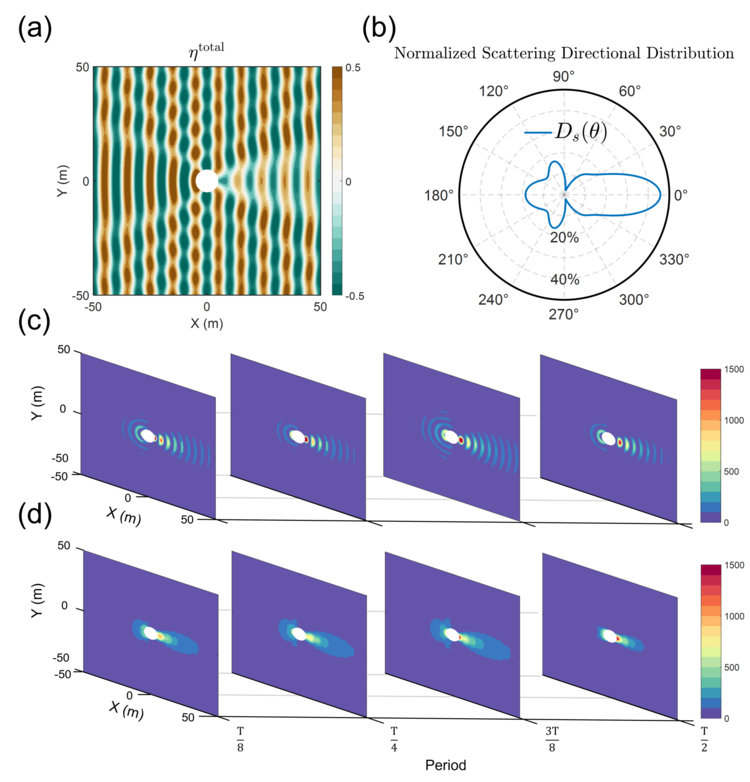
Extensive offshore renewable energy installations have raised concerns about their environmental impacts. These concerns highlight the need for high fidelity modeling of conditions within wind-farm regions, where wave–structure interactions through reflection, diffraction, and dissipation reshape local and regional wave dynamics, thereby influencing energy conversion efficiency and altering surrounding hydrodynamic conditions. However, accurately representing these wave–structure interactions remains a major challenge for wave models, which often oversimplify turbines as energy sinks and thus introduce nonphysical dissipation. This study develops a new parameterization to represent distinct regimes of wave-structure interactions according to the ratio of wavelength to structural size. When wave and structure scales are comparable, wave scattering dominates and is represented as an energy-conserving source term based on diffraction theory, allowing for directional redistribution of wave energy. Drag-induced dissipation dominates for cases where the wavelength greatly exceeds the structural scale and is parameterized by a dissipative source term. Both regimes are formulated within a unified framework and implemented in the wave spectral model, WAVEWATCH III. Numerical simulations demonstrate that the proposed parameterization improves the physical realism of wave–structure interactions. The modeled wave field exhibits a strong dependence on wave–structure scale ratio and a distinct spatial pattern in significant wave height, with amplification upstream of the farm and attenuation downstream. These findings offer a physics-based solution, supporting future offshore renewable energy development and improving the understanding of its impacts on the marine environment.